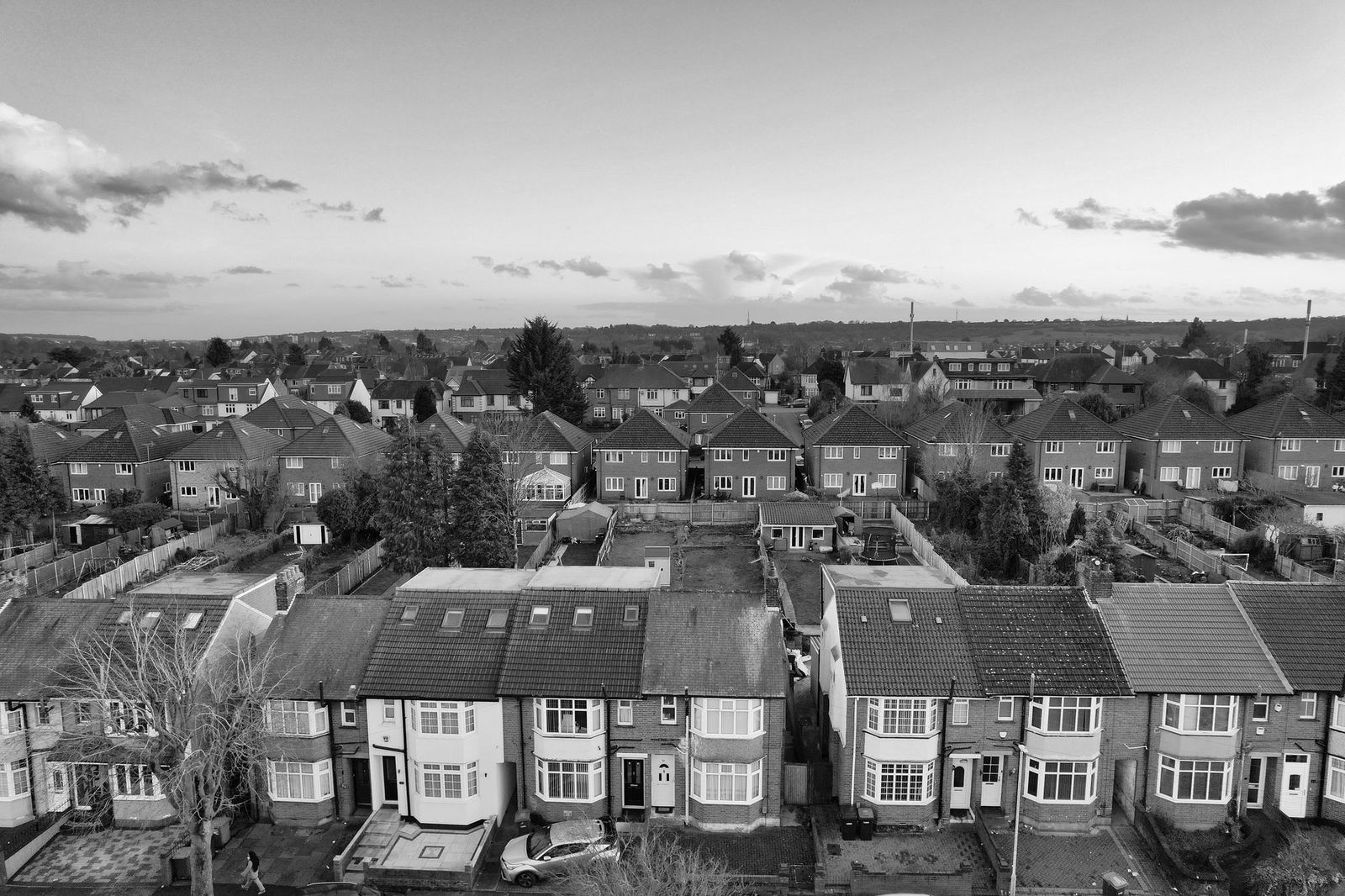
New build vs. 1930s semi: we ran the numbers on both
Few property arguments turn tribal as fast as this one. One camp says new builds are shoebox rooms, cardboard walls and a garden you can mow from the doorstep. The other says period houses are cold, damp money-pits held together by their own woodchip. Both sides are quoting vibes. Neither is quoting numbers.
We have the numbers. We analysed the national Energy Performance Certificate register and His Majesty's Land Registry sold-price data, putting the newest houses in the country against the interwar semi-detached — the single most common family home England ever built. Here is what the record actually says, and where it says something the tribes get wrong.
On energy, it isn't close
Start with the thing period-house romantics least want to hear. Across every house in our EPC data, energy performance climbs almost perfectly in step with the decade a home was built — a clean, monotonic staircase with no exceptions.
Group the national house stock by construction era and take the mean SAP score (the 1–100 efficiency rating behind the EPC band) and it reads like a ladder: pre-1900 homes average 50, the 1900–1929 stock 56, the 1930–1949 cohort 59.5, post-war 62.5, and the 2012-onwards stock 78.3. The share reaching band C or better tells the same story even more starkly — 8.5% of pre-1900 houses, 21% of 1930s houses, and 96% of houses built since 2012.
Now the head-to-head that gives this post its name. Narrow both sides to semi-detached houses — the fair fight, like against like — and the gap is a chasm:
- The 1930s semi (1,120,209 certificates in the study): mean SAP 59, median band D, and roughly one in twenty sits at band F or G. Modelled annual CO₂: 4.62 tonnes.
- The post-2012 semi (18,780 of them): mean SAP 78, median band C, and 97.4% reach band C or above. Modelled annual CO₂: 2.04 tonnes — less than half.
Same footprint, same street corner, roughly the same shape. The modern semi throws away less than half the carbon and sits two-plus bands higher, because it was built to a fabric standard the 1930s bricklayer had never heard of: filled cavity walls, a metre of loft insulation, double glazing as standard, a condensing boiler or a heat pump. This is not a rounding error you retrofit away in a weekend. It is the single most decisive number in the whole comparison, and it favours the new build without ambiguity.
If you fall for the period semi anyway — plenty of us do — go in knowing the bill. A band D or E house can absolutely be brought up, but retrofit is real money and real disruption: insulation, glazing, and increasingly a heat pump if you want off the gas. Cost it before you exchange, not after. Our companion pieces on what an EPC band actually means, how to improve an EPC rating and whether a heat pump is worth it are the place to start; the honest limits of the certificate itself we cover in how accurate is an EPC band.
The premium is real — but far smaller than the myth
"You pay 20% extra for a new build and lose it the day you move in." It's the most-repeated line in the genre, and it's half true in a way that matters.
Take every sale in England and Wales over the last three years — about 2.84 million transactions — and split by whether the home was new. The median new build sold for £334,995; the median existing home for £275,000. That's the famous ~22% premium, and if you stop reading there you'll believe the myth.
But that headline number is a trick of the mix, not a like-for-like. New-build sales skew heavily toward flats and toward pricier regions; the second-hand market is everything, including cheap terraces and grand period detacheds. Split by property type and the premium mostly evaporates:
- Semi-detached: new £274,995 vs existing £262,500 — a £12,495 premium, under 5%.
- Terraced: new £250,000 vs existing £220,000 — about 14%.
- Detached: new £400,000 vs existing £417,500 — the new build is cheaper, because the existing detached market is stuffed with large period houses.
- Flats: new £325,000 vs existing £220,000 — a 48% gap, and the single line dragging the whole headline upward.
So for the specific fight in this post — a new semi versus an old one — you are paying roughly five per cent more for the modern house, not twenty. Five per cent to halve your energy use is a defensible trade, and a very different proposition from the caricature.
One honest caveat we can't quantify from this study. The other half of the myth — that a new build sheds its premium on resale — needs to follow the same house from first sale to second, which these sold-price records do not reliably support. Treat any "new builds depreciate" claim (ours or anyone's) as unproven here. What the cross-section above shows is the premium at the point of sale, not its decay.
Where the 1930s semi actually wins
This is not a rout, and pretending otherwise would be the same vibes-based nonsense we're trying to kill. The period house wins real things, and one of them is measurable in the record.
Space. The tribal knock on new builds — cramped rooms — has a factual core. The median internal floor area of a 1930s semi in our EPC data is 91.8 m²; the post-2012 semi is 89.5 m². It's a small gap, but it runs the opposite way to the price: you pay slightly more for the new house and get slightly less floor for it. And that's before the garden. Plot size isn't in the EPC or price datasets — we won't invent a figure for it — but anyone who has stood in both back gardens knows the interwar semi, built when land was cheap and density targets didn't exist, typically has the deeper plot. If a workshop, an extension or a trampoline matters to you, the older house usually has the room for it — and often the permitted development headroom to build, where a modern estate house can be boxed in by a planning condition that strips those rights away.
Snagging vs. maintenance. Here we're outside what these records can measure, so we'll flag it as argument, not measurement: a new build hands you a snagging list — the cracked tile, the door that won't shut, the boiler installed by someone in a hurry — but also a warranty and a decade before anything major is due. A ninety-year-old house hands you a roof that's on borrowed time and wiring of uncertain vintage, but it has already proved it won't fall down. Pick your risk profile. Neither is free.
The verdict
On the evidence, there's no universal winner — there's a winner for you, and the data makes the choice legible instead of tribal.
Buy the new semi if low running costs and a quiet first decade are what you're optimising for. You'll pay about five per cent more, live two EPC bands warmer, emit less than half the carbon, and inherit a snagging list instead of a maintenance backlog. For most first-time buyers who can't also fund a £20k retrofit, that is quietly the sensible answer.
Buy the 1930s semi if you want the space, the plot, the bay window and the scope to make it yours — and you're willing to treat the energy gap as a project with a budget, not a surprise. Go in with the retrofit costed and the EPC read properly, and it's a fine house. Go in on romance alone and the winter bills will find you.
What you shouldn't do is decide it on a forum. The public record can help you compare the specific two houses in front of you, not just the archetypes. You can ask about any property directly or review its evidence in Explorer. If you want to go deeper first, what a home is actually worth, the fabric of the building itself and home energy ratings explained each take one thread of this apart.
Methodology and limitations
Sources and scope. The EPC register and HM Land Registry Price Paid Data, analysed on 18 July 2026. This is an aggregate comparison of construction-era cohorts, not matched pairs of individual homes.
- Energy gradient: valid house certificates grouped by construction era show mean SAP rising from 50.0 before 1900 to 78.3 from 2012 onward, while the share reaching band C or better rises from 8.5% to 96.3%.
- Semi head-to-head: 1930s semis (n=1,120,209) average SAP 59.3, median floor area 91.8 m², modelled CO₂ 4.62 t/yr, with 19.5% at band C or above. Post-2012 semis (n=18,780) average SAP 78.2, median floor area 89.5 m², modelled CO₂ 2.04 t/yr, with 97.4% at C or above.
- Band distribution: the 1930s cohort is modal band D (54.5%) with roughly 5% at F/G; the post-2012 cohort is modal band C (84%) with 2.6% below C.
- Price premium: among 2,843,975 transactions since 2023, the overall median is £334,995 for new homes and £275,000 for existing homes. By type, the premiums are semi +£12,495 (4.8%), terraced +£30,000 (13.6%), flat +£105,000 (48%), while detached is −£17,500 (−4.2%).
Limitations, stated plainly. Price Paid Data covers England and Wales only — no Scotland or Northern Ireland. Construction-age bands are assessor-entered; we used the standard national bands and excluded free-text and unusable values, so the cohorts are large but not the whole register. "New build" is Land Registry's own flag at point of sale. SAP scores and CO₂ are modelled estimates, not metered consumption — useful for comparing millions of homes, but weak for judging any one of them (see how accurate is an EPC band). Above all, this is a cohort comparison: it describes the average 1930s and modern semi, not the two specific houses you're choosing between. Plot and garden size are unavailable, so we describe them qualitatively and give no figure. This study also cannot establish how a new-build premium changes on resale.
Ask the House about any property
Get grounded answers on the risks, value, planning, and energy behind any UK home — plain English, no jargon. Free to try.